
Cut-Resistant Gloves: EN 388 vs ANSI A1-A9, Explained for Buyers
Navigating industrial hand protection standards is one of the most demanding tasks for procurement managers, safety directors, and PPE distributors. When evaluating cut-resistant work gloves for metal fabrication, automotive stamping, glass handling, or construction, buyers are confronted with two dominant regulatory frameworks: the European EN 388:2016+A1:2018 standard and the North American ANSI/ISEA 105-2016 (updated 2024) standard.
While both frameworks evaluate the force required for a razor blade to cut through protective textiles, their test methodologies, scoring scales, and rating categories differ fundamentally. Sourcing the wrong cut level compromises operator safety or results in excessive unit procurement costs for over-specified gloves.
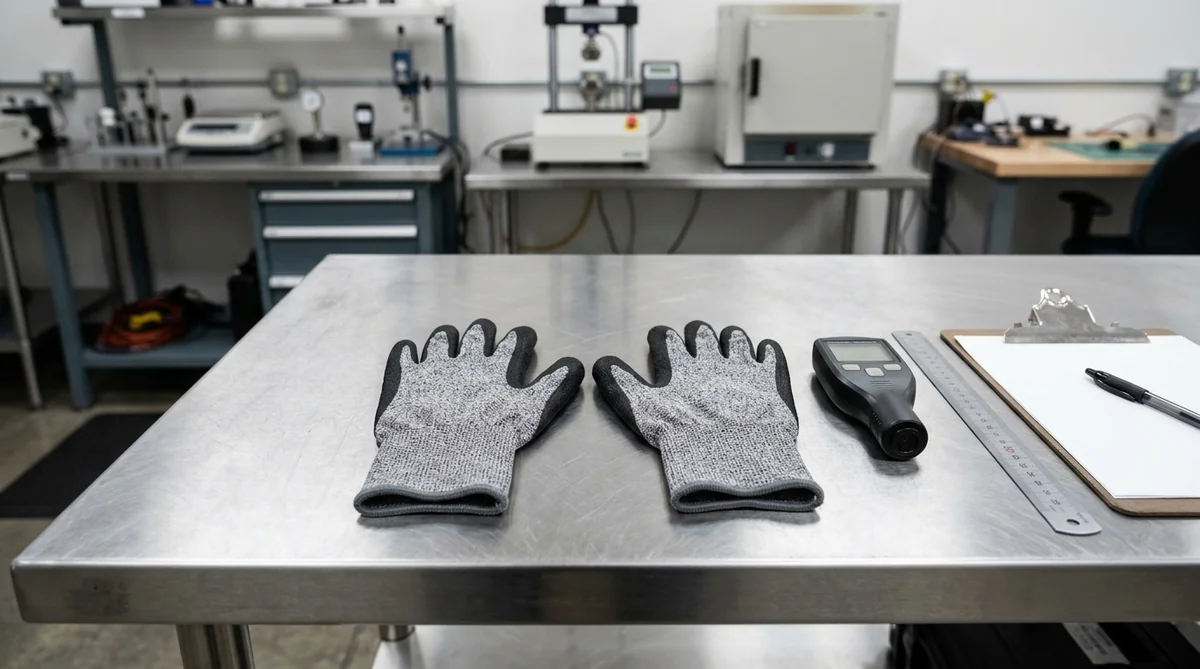
Procurement Summary:•European Standard: EN 388:2016 (Coupe Index 1–5 & ISO 13997 TDM Levels A–F)•American Standard: ANSI/ISEA 105 (ASTM F2992-15 Scale A1–A9 from 200g to 6000g+)•Key Glove References: HG-G-04 Grey Coated Cut-Resistant Knit Gloves, HG-G-14 Cut-Resistant Work Gloves•MOQ & Samples: MOQ 100 pairs per style/model (sizes split inside). Sample minimum 5 pairs per style, paid in advance, quoted separately, never free. Sample 7–10 days, production 30–45 days.•Multi-Division Policy: Order gloves, jackets or surgical instruments on their own — or combine divisions in one order and one shipment if you wish. Ordering all three together is NOT required.•Published: 11 Nov 2026 | Author: Halvex Group, Sialkot
Request Accredited Cut-Resistant Glove Samples
Source certified cut-resistant work gloves directly from our Sialkot manufacturing facilities. Review test reports and receive physical counter-samples in 7–10 days.
Cross-Standard Comparison: EN 388 (ISO 13997) vs ANSI/ISEA 105
The table below provides a direct technical conversion between the ISO 13997 Newton scale and the ANSI/ISEA 105 gram-force scale, paired with target industrial applications and Halvex product references.
| EN 388 ISO Level | Cut Force (Newtons) | ANSI/ISEA Cut Level | Cut Force (Grams) | Typical Workplace Applications | Recommended Halvex Product |
|---|---|---|---|---|---|
| Level A | >= 2 N | ANSI A1 | 200–499 g | General warehousing, carton packing, light maintenance | Confirmed in quotation |
| Level B | >= 5 N | ANSI A2 | 500–999 g | Small parts assembly, automotive interior trim, packaging | Confirmed in quotation |
| Level C | >= 10 N | ANSI A3 | 1,000–1,499 g | Sheet metal handling, electrical wiring, light stamping | Confirmed in quotation |
| Level D | >= 15 N | ANSI A4 | 1,500–2,199 g | Glass manufacturing, metal fabrication, HVAC installation | Confirmed in quotation |
| Level E | >= 22 N | ANSI A5 | 2,200–2,999 g | Heavy stamping, scrap metal sorting, meat processing | HG-G-14 Cut-Resistant Gloves (performance levels confirmed in the quotation) |
| Level F | >= 30 N | ANSI A6–A9 | 3,000–6,000+ g | Heavy foundry work, high-speed blade sharpening, demolition | HG-G-14 Cut-Resistant Gloves (performance levels confirmed in the quotation) |
Request a Factory-Direct Glove Quotation
Halvex Group manufactures OEM industrial, driver, and mechanic gloves with a minimum order quantity of 100 pairs per style (sizes split inside). Sample minimum 5 pairs per style, delivered in 7–10 days.
Technical Yarn Engineering: How Cut Resistance is Built
A common misconception among first-time buyers is that glove thickness determines cut resistance. In modern PPE manufacturing, cut performance is governed by yarn chemistry and core wrapping geometry rather than fabric bulk.
1. High-Performance Polyethylene (HPPE)
HPPE (known commercially under brand names such as Dyneema or Spectra) forms the backbone of modern 13-gauge and 18-gauge cut-resistant seamless knit liners. HPPE fibers are 15 times stronger than steel on a weight-for-weight basis. They offer low linting, cool touch sensations, and excellent tactile dexterity, as featured in our HG-G-04 Grey Coated Cut-Resistant Knit Gloves.2. Aramid Fibers (Kevlar)
Aramid yarns deliver inherent flame resistance alongside moderate cut protection. They do not melt or support combustion in air, making aramid liners the premier choice for welding, automotive exhaust assembly, and high-heat stamping.3. Composite Core Yarns (Steel Wire & Basalt / Glass Fiber)
To achieve extreme cut ratings (ANSI A4 to A9 / ISO Level D to F), yarn spinners wrap an ultra-fine stainless steel wire or fiberglass filament inside outer strands of HPPE or nylon. When a sharp blade edge strikes the glove, the blade slides over the hard mineral core without slicing the structural textile. Our HG-G-14 Cut-Resistant Gloves utilize composite steel-core HPPE engineered for heavy sheet metal stamping.Choosing the Right Palm Coating: PU vs Nitrile vs Latex
The palm dip formulation determines grip performance in dry, wet, or oily industrial conditions:
- Polyurethane (PU) Dip: Delivers maximum tactile sensitivity, breathability, and dry grip. PU coatings do not shed lint or leave fingerprints, making them ideal for electronics assembly and aerospace components. However, PU provides limited barrier protection against heavy oils.
- Micro-Foam Nitrile: Acting like tiny suction cups, micro-foam nitrile channels surface oils away from the contact area, providing exceptional mechanical grip on lubricated automotive stamping parts.
- Sandy Nitrile: Infused with textured particulate salts during the vulcanization process, sandy nitrile provides rugged abrasion resistance and superior grip in wet slurry, hydraulic fluid, and oily construction environments.
- Crinkle Latex: Provides unmatched tearing and gripping traction on dry timber, concrete masonry blocks, and corrugated boxes, but degrades when exposed to petroleum hydrocarbons.
Buyer Verification Checklist for Cut-Resistant Glove Tenders
Before awarding a bulk contract to an overseas manufacturer, require your vendor to supply the following compliance documentation:
- Accredited Lab Test Report: Verify test certificates issued within the last 24 months by an accredited testing body (SATRA, CTC, Intertek, or SGS). Confirm the certificate matches the exact liner yarn weight, gauge, and palm coating specified in your quote.
- Batch Consistency & Marking Compliance: Ensure the CE shield with mechanical pictograms or ANSI cut logo is stamped indelibly on each glove with the manufacturer's identification and sizing code.
- Washability & Dimensional Stability: Industrial laundries require gloves to retain cut levels after multiple industrial wash cycles. Verify whether coatings crack or delaminate after thermal washing.
Commercial Terms: MOQ, Sampling, and Production Lead Times
Halvex Group manages contract manufacturing and export logistics with transparent commercial benchmarks:
- Minimum Order Quantity (MOQ): Our standard MOQ is 100 pairs per style/model (sizes can be split within the 100 pairs across S, M, L, XL, XXL).
- Sampling Protocol: Sample minimum is 5 pairs per style, paid in advance, quoted separately, never free. Sample cost is quoted separately. Sample turnaround is 7–10 days.
- Production Lead Times: Bulk manufacturing requires 30–45 days following final counter-sample approval.
- Multi-Division Ordering Flexibility: Order gloves, jackets or surgical instruments on their own — or combine divisions in one order and one shipment if you wish. Ordering all three together is NOT required.
Frequently Asked Questions
What is the main difference between EN 388 Level C and ANSI A3?
EN 388 Level C requires a minimum cut force of 10 Newtons (approximately 1,020 grams) on the ISO 13997 TDM test. ANSI A3 covers the range between 1,000 grams and 1,499 grams on the ASTM F2992-15 test. They represent equivalent protection thresholds for sheet metal and assembly work.Why do some glove gloves show both a number and a letter for EN 388 cut ratings?
Gloves tested under EN 388 display a 4-digit code (e.g., 4X42) followed by a letter (A through F). If the Coupe test was bypassed or experienced blade dulling, an 'X' appears in the second position, and the mandatory ISO 13997 letter score appears at the fifth position.Can cut-resistant gloves also provide impact protection?
Yes. Modern technical gloves combine cut-resistant composite HPPE liners with molded Thermoplastic Rubber (TPR) armor across the knuckles and dorsal fingers, certified to EN 388:2016 impact (marked 'P') and ANSI/ISEA 138 (Levels 1 to 3).What is the typical MOQ for custom cut-resistant gloves from Halvex Group?
Our standard MOQ is 100 pairs per style/model with split sizing across standard sizes. Sample minimum is 5 pairs per style, delivered in 7–10 days.Start Your Cut-Resistant Hand Protection Brief
Whether you need to standardize safety PPE across national distribution centers or develop a private label high-dexterity cut line, our engineering team in Sialkot is ready to assist.
Explore our Safety Gloves Manufacturer & OEM Exporter Sialkot catalog, review our quality testing benchmarks, or submit your technical specifications through our B2B Quote Request Form. You can also contact our team directly at sales@halvexgroup.com or via WhatsApp on +92 343 6432568.