
Surgical Instruments Suppliers in Sialkot: ISO & CE Compliance Guide
Selecting an experienced surgical instruments supplier in Sialkot is a critical strategic decision for hospital procurement directors, healthcare distributors, and medical device brands worldwide. Sialkot manufactures a significant portion of the world's handheld stainless steel surgical, dental, and veterinary tools. However, navigating this extensive manufacturing district requires a disciplined, specification-first methodology. A successful commercial program does not depend on generic catalog numbers. It depends on whether your sourcing partner can translate clinical requirements into verified metallurgy, precise jaw alignment, defect-free passivation, and reproducible bulk production.
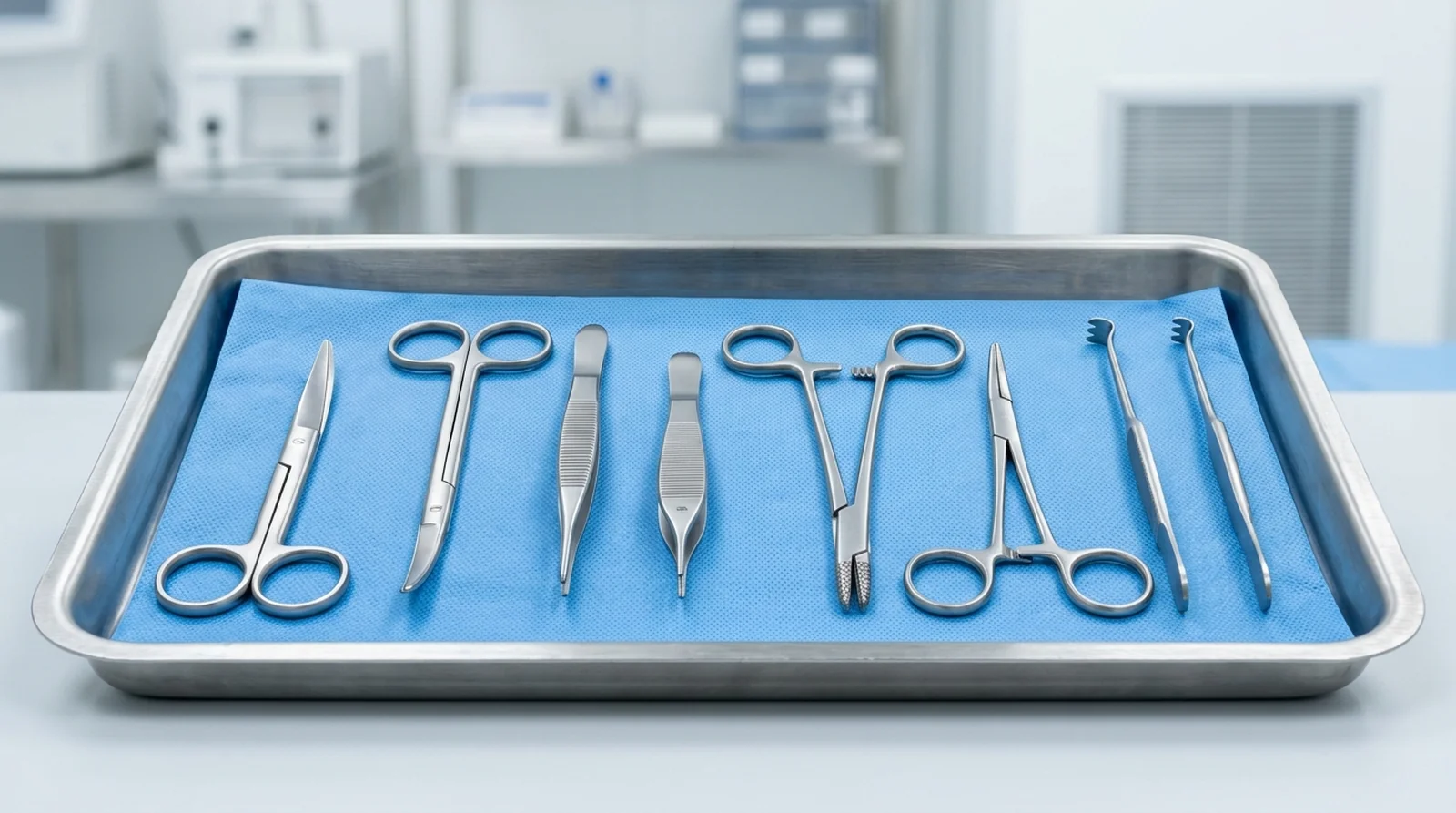
Whether you are contracting high-volume single-use forceps or developing private label reusable surgical sets, this guide outlines every procurement phase. We examine metallurgical steel grades (ISO 7153-1), international regulatory compliance (ISO 13485, EU MDR, FDA), pattern drafting, sample testing protocols, quality control checkpoints, and cleanroom export packaging.Procurement Summary:•Material Grade: Medical-Grade Stainless Steel (AISI 304, 410, 420A/B/C) & Tungsten Carbide (TC)•Quality Standards: ISO 13485 Certified QC, CE Medical Device Compliance (EU MDR 2017/745), FDA Device Listing•Finishing Options: Non-Reflective Satin Matte, Mirror Polish, Tungsten Carbide (TC) Gold Handles•Traceability: Custom laser-etched SKU numbers, lot/batch tracking, UDI compliance, and custom private label logos
🔬 Partner with an ISO Certified Sialkot Manufacturer
Source premium stainless steel surgical instruments direct from an ISO certified surgical instruments supplier. Submit your clinical patterns, CAD drawings, or sample references for prototype delivery in 7–10 days. Submit Instrument Brief & Request a Quote →---
Precision Forging: Sialkot’s World-Class Medical Instrument Heritage
For over a century, Sialkot in northeastern Pakistan has served as a specialized global cluster for precision metalcraft and medical toolmaking. The district supports a mature industrial infrastructure dedicated to hot-drop forging, precision milling, hand-filing, heat treatment, passivation, and ultrasonic cleaning.
When evaluating a ce certified medical instruments exporter or an iso 13485 surgical tools factory in Pakistan, international medical procurement managers benefit from four major advantages:
- Specialized Multi-Tier Cluster: Sialkot houses an integrated supply ecosystem of forging workshops, specialized tooling technicians, heat treatment facilities, and laser marking centers. This density allows for rapid prototyping and cost-effective production across thousands of distinct medical patterns.
- Master Hand Craftsmanship: Despite advancements in CNC milling, delicate surgical instruments (such as iris scissors, micro-forceps, and delicate skin hooks) depend on artisan hand-filing to balance scissor blade curvature, set box-lock tension, and align micro-serrations.
- Broad Specialty Portfolio: Sialkot factories produce over 15,000 distinct instrument patterns spanning general surgery, gynecology, obstetrics, orthopedics, cardiovascular, ENT, ophthalmology, and dental surgery.
- Export Discipline & Technical Documentation: Seasoned Sialkot exporters understand international customs requirements, Certificate of Origin filings, material test reports (MTRs), and consignment tracking for healthcare distributors worldwide.
At the same time, technical capability and regulatory compliance vary across the district. While top-tier facilities operate validated ISO 13485 cleanrooms, passivated passivation baths, and optical shadowgraph inspection stations, smaller informal workshops may use unverified steel or lack traceable batch documentation. Working with an experienced local sourcing partner such as Halvex Group ensures your technical specifications, documentation standards, and quality criteria are rigorously audited before goods depart Sialkot.
---
Halvex Group Surgical Instrument Families & Catalog References
Halvex Group's surgical instruments division coordinates manufacturing across two core clinical product categories: General Surgery and Obstetrics & Gynecology. The table below details our reference items, clinical functions, and the key mechanical details buyers must specify in their Request for Quotation (RFQ).
| Halvex Reference | Clinical Family | Instrument Name | Common Pattern Examples | Essential Technical Specifications |
|---|---|---|---|---|
| HG-S-01 | General Surgery | Scalpel Handles | Bard-Parker #3, #4, #7 | Fitment size (#10-#15 vs. #20-#25 blades), metric rule etching, satin finish |
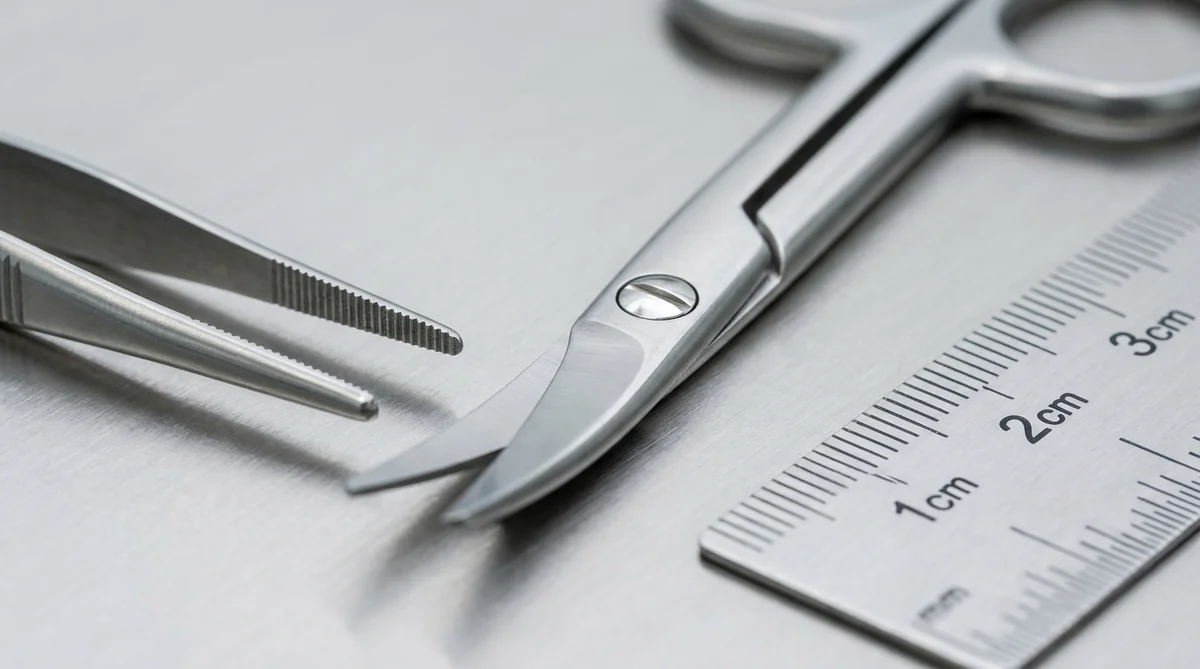
| HG-S-02 | General Surgery | Operating Scissors | Mayo, Metzenbaum, Iris | Straight vs. curved, blunt/blunt vs. sharp/blunt, tungsten carbide (TC) inserts |
| HG-S-03 | General Surgery | Surgical Forceps | Adson, DeBakey, Kelly | 1x2 teeth vs. serrated tips, tip width (0.8–2.0 mm), spring tension |
| HG-S-04 | General Surgery | Surgical Retractors | Senn-Miller, Richardson, Langenbeck | Blade depth/width, prong style (sharp vs. blunt), handle ergonomics |
| HG-S-05 | General Surgery | Tissue Forceps | Allis, Babcock, Lane | Jaw fenestration, teeth configuration (4x5 vs. 5x6), ratchet locking action |
| HG-S-06 | General Surgery | Surgical Suction Instruments | Yankauer, Frazier, Poole | Lumen French gauge (6 Fr to 12 Fr), finger cut-off valve, cleaning access |
| HG-S-13 | General Surgery | Bulldog Clamps | DeBakey, Dieffenbach, Johns Hopkins | Atraumatic jaw serration, closing spring tension (grams force), cross-action |
| HG-S-14 | General Surgery | Vein Stripper Instruments | Nabatoff, Myers, Crawford | Cable tensile strength, interchangeable head diameters, storage case |
| HG-S-07 | Obstetrics & Gynecology | Vaginal Specula | Graves, Pederson, Cusco | Blade dimensions (length/width), center-screw glide, insulated LEEP coating |
| HG-S-08 | Obstetrics & Gynecology | Vaginal Retractors | Auvard, Doyen, Breisky | Weighted ball specification (2.0–3.0 lbs), blade angle, polished surface |
| HG-S-09 | Obstetrics & Gynecology | Uterine Forceps | Bozeman, Foerster sponge | S-curve vs. straight, box-lock alignment, delicate non-slip serrations |
| HG-S-10 | Obstetrics & Gynecology | Biopsy Forceps | Tischler, Kevorkian, Schumacher | Punch jaw dimensions (e.g., 3x7 mm), bite sharpness, cross-pin stability |
| HG-S-11 | Obstetrics & Gynecology | Surgical Curettes | Sims, Recamier, Novak | Sharp vs. blunt loop, rigid vs. malleable shaft, serrated scraping edge |
| HG-S-12 | Obstetrics & Gynecology | Obstetric Forceps | Simpson, Kielland, Piper | Cephalic and pelvic curvature, sliding vs. English lock, handle traction |
| HG-S-15 | Obstetrics & Gynecology | Uterine Dilators | Hegar, Pratt, Hank | Graduated double-ended sizing (1/2 mm up to 25/26 mm), smooth bullet tip |
| HG-S-16 | Obstetrics & Gynecology | Gynecology Speculum | Collin, Kristeller, Graves | Matte vs. mirror finish, smoke evacuation port option, set presentation |
---
Stainless Steel Metallurgy: Understanding ISO 7153-1 Compliance
The clinical performance, edge retention, and rust resistance of handheld medical instruments depend directly on the metallurgical grade of stainless steel utilized. Sialkot's top manufacturers source certified medical-grade stainless steel wire and bar stock from reputable European and Asian mills.
The international standard ISO 7153-1 governs metallic materials for surgical instruments, categorizing alloys into martensitic and austenitic groups.
Martensitic Stainless Steels (Hardenable)
Martensitic steels contain higher carbon content (0.15% to 1.2%) and moderate chromium (11.5% to 18%). They are hardenable through heat treatment (quenching and tempering), achieving high Rockwell hardness (HRC) necessary for sharp cutting edges, spring action, and durable box-lock ratchets.- AISI 410 / 420A (HRC 42–48): Balanced toughness and moderate hardness. Commonly used for forceps handles, retractor blades, and specula where extreme edge sharpness is not required.
- AISI 420B / 420C (HRC 50–55): Higher carbon content delivering superior hardness and edge retention. The premier standard for surgical scissors, scalpel blades, bone rongeurs, and biopsy punches.
- Tungsten Carbide (TC) Inlays: For premium surgical scissors and needle holders, gold-handled instruments feature sintered tungsten carbide plates brazed into jaw tips. TC provides an extreme hardness of HRC 70+, dramatically extending cutting and clamping lifespan.
Austenitic Stainless Steels (Non-Hardenable)
Austenitic steels (such as AISI 304 and 316) contain nickel (8% to 14%) and chromium (16% to 20%). They cannot be hardened by heat treatment, but they offer superior corrosion resistance and ductility.- AISI 304: Used for hollowware, instrument trays, suction tubes, and malleable retractors that surgeons bend intraoperatively.
- AISI 316 / 316L: Contains 2% to 3% molybdenum, providing outstanding resistance to pitting and crevice corrosion in chloride environments. Used for surgical implants and specialized cannulas.
| Steel Grade | Structure Type | Typical Hardness | Primary Applications | Corrosion Resistance |
|---|---|---|---|---|
| AISI 410 | Martensitic | HRC 40–46 | Hemostatic forceps, specula, retractors | Moderate |
| AISI 420A/B | Martensitic | HRC 48–54 | Operating scissors, scalpels, curettes | Good |
| AISI 420C | Martensitic | HRC 52–56 | Precision micro-scissors, bone rongeurs | Good |
| AISI 304 | Austenitic | Non-hardenable | Trays, suction tubes, malleable shafts | Superior |
| AISI 316L | Austenitic | Non-hardenable | Cannulas, specialty suction, implants | Exceptional |
| Tungsten Carbide | Sintered Carbide | HRC 70+ | TC scissor blades, needle holder jaws | Exceptional wear |
Surface Passivation and Corrosion Prevention
Even high-grade stainless steel will rust if surface contaminants remain after machining. Free iron particles deposited during grinding or filing must be removed chemically through passivation.
Standard passivation follows ASTM A967 or ISO 16061:
- Ultrasonic Cleaning: Immersion in an alkaline degreasing bath at 60°C to dissolve machining oils, polishing compounds, and particulate dirt.
- Acid Passivation Bath: Immersion in a 20% to 25% nitric acid or citric acid solution at controlled temperature. Acid dissolves free iron from the surface without attacking chromium, forming an inert, microscopically thin chromium oxide passive film ($\text{Cr}_2\text{O}_3$).
- Deionized Water Rinse & Neutralization: Complete rinsing in multi-stage deionized water baths to halt chemical reactions.
- Corrosion Verification Testing: Batch samples undergo testing according to ASTM F1089 (Standard Test Method for Corrosion of Surgical Instruments), including:
- Boil Test: Immersion in boiling distilled water for 30 minutes, followed by 3-hour air drying. Any rust stains indicate failed passivation.
- Copper Sulfate Test: Application of copper sulfate solution to detect free iron deposits within 6 minutes.
---
Regulatory Compliance & Quality Inspection (ISO 13485 & CE)
International medical device buyers operate under strict regulatory scrutiny. Sourcing requires verifying four core quality frameworks:
- ISO 13485 Certification: Validates comprehensive quality management systems specifically for medical devices, ensuring risk management (ISO 14971), cleanroom sanitation, batch traceability, and CAPA procedures.
- European CE Marking (EU MDR 2017/745): Reusable surgical instruments are classified as Class I or Class Ir (reusable surgical instruments requiring a notified body certificate for reuse/sterilization). Exporters must provide complete Technical Files, clinical evaluations, and Declarations of Conformity.
- FDA Device Establishment & Listing: Facilities exporting to the United States must maintain active FDA Establishment Registration and list their device categories under 21 CFR Part 820 (Quality System Regulation).
- Unique Device Identification (UDI): Modern regulations require high-resolution laser-marked 2D DataMatrix barcodes on instruments, encoding Global Trade Item Numbers (GTIN), lot numbers, and serial numbers for hospital inventory tracking.
---
The 4-Stage Medical Prototype & Sampling Workflow
- CAD & Pattern Review: Technical drawings, common clinical pattern names (e.g., Metzenbaum scissors 18 cm, Adson forceps 12 cm), or sample pieces are reviewed for blade curvature, tooth pitch, and box-lock tolerances.
- Precision Forging & Filing: Drop-forged blanks are hand-filed by master artisans. Initial prototype counter-samples are delivered within 7 to 10 business days.
- Autoclave Cycle & Caliper Audit: Prototype instruments undergo 5x steam autoclave cycles (134°C at 2.1 bar) to verify pivot screws, springs, and ratchet teeth against corrosion or binding.
- Mass Production & Release: Batch manufacturing proceeds under ISO 13485 oversight, ending with ASTM F1089 boil testing and cleanroom export pouching.
Critical Verification Checkpoints for Medical Buyers
- Visual & Finish Audit: Inspect under 5x magnification. Check for uniform satin bead-blasting, absence of micro-burrs along edges, and seamless box-lock closure.
- Functional Action Check:
- Scissors: Blades must open and close smoothly without hitching, cutting cleanly through four layers of medical gauze all the way to the tip without pushing material.
- Forceps: Tips must meet with perfect concentric alignment without lateral twisting.
- Clamps and Needle Holders: Ratchet teeth should engage crisply with progressive tactile resistance, holding firm on the third ratchet tooth without slipping.
---
Commercial Terms: MOQ, Lead Times, and Pricing
Procurement managers should structure purchase orders to align with Sialkot's forging and batch-machining economics:
- Standard Catalog Patterns: For widely produced patterns in standard sizes (e.g., Mayo scissors, Kelly forceps), initial trial orders can start around 25 to 50 pieces per pattern.
- Custom Tooling or Bespoke Modifications: Unique instrument patterns requiring custom forging dies or specialized milling fixtures typically start around 100 to 200 pieces.
- Sampling Turnaround: Proto-sample manufacturing generally takes 7 to 10 working days for precision forging, filing, heat treatment, and passivation.
- Bulk Production Timelines: Mass manufacturing after final sample sign-off typically requires 35 to 50 days depending on volume, pattern variety, and packaging complexity.
Beware of vendors offering prices 30% to 50% below market norms. Significant price reductions in Sialkot surgical manufacturing invariably stem from substituting low-grade industrial scrap steel for medical-grade AISI 420, skipping vacuum heat treatment (resulting in soft, easily blunted jaws), or omitting acid passivation (leading to post-sterilization rusting).
---
Export Packaging, Set Assembly, and Logistics
Surgical tools require specialized protective packaging to ensure fine scissor tips, delicate forceps teeth, and sharp curettes arrive without transit damage.
As outlined on our international trade and global presence page, export packaging standards include:
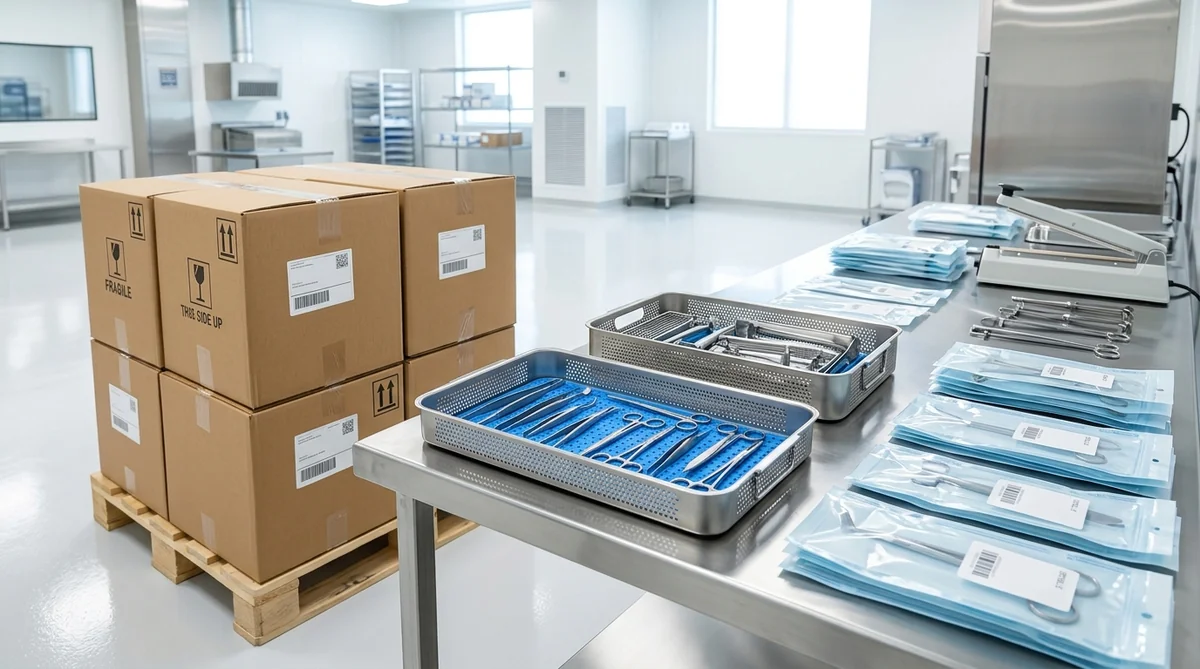
- Tip and Edge Protection: Delicate working tips must be protected with medical-grade silicone protector sleeves (vented for steam sterilization).
- Inner Unit Packaging: Instruments are sealed inside clear medical-grade polybags with silica packs, or packed in peelable chevron pouches ready for ethylene oxide (EtO) or autoclave sterilization.
- Surgical Set Building: For clinical procedure trays (such as minor surgery sets or gynecological biopsy kits), instruments are arranged in custom anodized aluminum or stainless wire mesh trays with medical-grade silicone holding racks.
- Master Carton Packing: Inner boxes are placed inside heavy-duty 5-ply double-wall export cartons lined with plastic moisture-barrier film. Cartons are strapped, palletized on heat-treated ISPM-15 wooden pallets, and wrapped with security film.
---
Where Halvex Group Fits in Your Medical Supply Chain
Halvex Group is a specialized B2B supplier and sourcing partner headquartered in Sialkot, Pakistan. We connect international medical distributors, private label brands, and hospital supply chains with verified manufacturing facilities in our industrial cluster.
Our organization delivers:
- Medical Specification Translation: We review your catalog numbers, CAD drawings, or physical samples and match them with specialized forging and finishing workshops.
- Multi-Category Procurement Consolidation: Overseas healthcare distributors sourcing surgical tools alongside protective medical gloves or uniform apparel can coordinate orders, documentation, and quality inspections through a single unified commercial channel.
- Rigorous On-Site Quality Control: Our inspection teams perform incoming steel verification, jaw alignment audits, ASTM F1089 boil tests, and laser marking inspections before export release.
- Transparent Commercial Terms: An inquiry is never an order. Specifications, lab certifications, sampling budgets, and shipping options are explicitly verified in writing for every individual project.
Learn more about our company background on the About Halvex Group page, explore our five-stage manufacturing workflow, or review our quality assurance protocols.
---
Frequently Asked Questions
What should be included in a surgical instrument quotation request?
A complete surgical instrument RFQ should include the exact instrument pattern name, Halvex reference (HG-S-01 to HG-S-16) or equivalent catalog code, length in millimeters, tip or jaw configuration (straight vs. curved, serrated vs. toothed), stainless steel grade (AISI 420A/B/C, 410, 304), surface finish (satin vs. mirror), laser marking artwork, packaging format, target volume, and destination delivery port.Do I need an exact catalog number to request a quotation?
No. An exact manufacturer catalog number is not required to begin. You can initiate an inquiry with a common clinical pattern name, high-resolution photograph, technical sketch, or physical sample. Our engineering team will clarify dimensions, jaw configurations, and metallurgical options during specification review.Which stainless steel grades are used for Sialkot surgical instruments?
Surgical instruments utilize martensitic and austenitic stainless steels governed by ISO 7153-1. Martensitic grades such as AISI 420A, 420B, and 420C are heat-treated to achieve HRC 48–55 for sharp cutting edges, scissor blades, and locking ratchets. Austenitic grades such as AISI 304 and 316 provide superior corrosion resistance for retractors, suction tubes, and instrument trays.What quality control checks should be performed on surgical instrument samples?
Evaluate samples across four parameters: visual surface audit under magnification (checking for burrs and seamless box locks), functional testing (smooth scissor action, clean gauze cut to the tip, teeth alignment on forceps, and ratchet grip), dimensional caliper verification, and corrosion testing via ASTM F1089 boil tests and multiple autoclave cycles.Can Halvex Group assemble and supply custom surgical sets?
Yes. We regularly coordinate custom surgical sets for general surgery, obstetrics, and gynecology. Buyers can specify individual instruments, sizes, and quantities. We arrange assembly into custom wire-mesh sterilization trays, silicone-matted containers, or customized zippered pouch cases according to your clinical specifications.What is the MOQ for surgical instruments from Sialkot?
Minimum order quantities vary by pattern, steel grade, and level of customization. For standard general surgery patterns in stock steel profiles, trial quantities may start around 25 to 50 pieces per pattern. Custom OEM instruments requiring bespoke forging dies typically start around 100 to 200 pieces. Always confirm MOQ per pattern during your initial inquiry.---
Start Your Surgical Instruments Inquiry
Whether you are looking to benchmark pricing on high-volume scissors and forceps, build custom procedure sets, or develop an OEM private label line, our technical sourcing team in Sialkot is ready to evaluate your brief.
Explore our Surgical Instruments Manufacturer & Exporter Sialkot catalog, review our quality assurance frameworks, or submit your technical specifications through our B2B Quote Request Form. You can also contact our team directly at sales@halvexgroup.com or via WhatsApp on +92 343 6432568.